Eva at A Striped Armchair had a
post yesterday about the annotated version of
Pride and Prejudice. For just the social commentary, I want this book. In writing my comment to her, I realized that I really want to do a post about Jane Austen.
Jane Austen is the incomparable wonderful exquisite first real female novelist of the English language. I'm not counting gothics here, nor male writers. When I look back in the history of the development of the English novel written by women, she stands foremost, head and shoulders above anyone else. Why does she cast such a beacon? Why are her books still read and loved almost 200 years later?
Eva in her post says that she started reading Jane Austen when she was 11. Eleven! I didn't discover Jane until much later in life. In fact, I can't remember how or when I first read Jane Austen. Just that suddenly, like much that I love, she was there one day, and a permanent fixture in my life. By the time I was 26 she was firmly fixed as one of my favourite writers. The father of my eldest son's best friend (we were all in university at the time, I had gone back to school after having my son, to get my BA in English Literature, and my son's friend's parents were studying at the same university, and our sons were in the same daycare) asked me who my favourite author was. I hate this question. I don't have a favourite author; I have many authors that I really enjoy, and a few that I can't part with, that go with me everywhere. So I said, "Jane Austen." Well, he was stunned, because he and his wife were avant-guarde artists! And here I was saying I liked a stuffy 19th century author most of all! but it's never really changed. And the late 1980's and early 1990's were all about breaking with tradition in the arts and exploring new ways of writing the novel. So I was out of step with the times, but then, I always have been.

My first love with Jane's books has to be with
Persuasion. I have no idea when or where I picked it up, just that the first time I read it, was a revelation for me. Not only could I read Jane Austen and understand it without ten million footnotes - anyone who has tried to
Clarissa (often thought of as the first epistolary novel in English) or
Tristam Shandy will know what I mean - but I laughed. I was delighted, I was moved, I loved Anne and loathed her pretentious family and delighted in Jane's clever put downs of them - which is something you or I might do about pretentious people today. I have always loved Captain Wentworth, who remained faithful in spite of trying to forget her - although my real hero has always been Darcy of
Pride and Prejudice. And I've never really forgiven Lady Russell for not seeing through Anne's cousin, even though it was Jane's way of showing that in the end, Anne did learn how not to be persuaded against her better judgement.
Persuasion has always been a powerful and gentle novel about the only power a woman had back then, which was who to choose to marry, and how she married - whether for money, or for love.

I might have sought out
Pride and Prejudice because of the Colin Firth/Jennifer Ehle tv production from the 1980's; I think I did. I was desperate to know if the book had any more of Darcy and Elizabeth, and to my joy, I discovered that P&P was as full of the witty comments and sparklng wit as
Persuasion. It was as even better than the TV show! there was more of Darcy and Elizabeth, and more of Jane's observations of life in early 1800's England. Elizabeth Bennett is my favourite Austen heroine. I would dearly love to meet her and she is someone who I could easily see being my best friend. One of the things I like best about this book is that they reflect and learn on their mistakes.
For me, one of the highlights of
Persuasion and P&P are the letters that Wentworth and Darcy send to Anne and Elizabeth. It is the first time that we see the men - these principal male characters - from inside their minds and hearts - and while Wentworth's letter is about a man succumbing to love a second time, Darcy's letter is about a man reaching out to defend himself to a woman he loves. This is the moment when I believe that he does, really love Elizabeth, and the rest of the novel is Elizabeth realizing that she was too proud, too, and didn't realize until too late what a perfect match they were.Darcy's letter shows that he is just, reasonable, kind, loving, honourable, and honest - all the qualities Elizabeth, and we readers, are looking for in the ones we hope to marry. In one masterful swoop, suddenly Elizabeth is no longer the slighted one (he refused to dance with her, sniffing no one in the room could tempt him but her sister Mary, and she was already taken by his friend), but the slightee - she never recognized that he was falling in love with her, although we as readers do, starting with as soon as the first social event is over and Mary and Bingley start spending other dances and social events in eachother's company, Darcy and Elizabeth see eachother, but do not mix yet:
"But no sooner had he made it clear to himself and his friends that she had hardly a good feature in her face, than he began to find it was rendered uncommonly intelligent by the beautiful expression of her dark eyes. ......He began to wish to know more of her." And to know Lizzie is enough to love her, as we readers all do. Except that she doesn't realize she is proud, until her treatment of Darcy shows to herself and us that she is, in her way, as proud as he is. And the way that she comes to know him and love him is the same way that he has come to know her and love her - after initial rejection. Oh yes, there is much to love in this novel. Darcy and Elizabeth are to me the perfect couple in English literature - smart, funny, honest, loyal, and they are also flawed - pride being their worst failing, and if I'm honest, it's probably mine as well. P&P is one of the great novels in English literature of all time. Even though it is a novel about love, and manners, the story it tells is timeless. You can change the setting and scenery, but the story is one that everyone tells about how and when they fell in love, too. "Well, first he did this, and I got mad and did this, but then I realized..."No love story ever went smoothly, there are always obstacles to overcome, and P&P is perhaps one of the cleverest love stories ever written. It is also full of social commentary, that explores different views on love that we still try to sort through today. I think this is why it is timeless, and about as perfect a novel on love as can be written.
Wentworth's letter to Anne in
Persuasion has the equal effect of revealing his emotions finally to her, and to us the reader. Once again, although we have his exploits as a naval officer and his treatment of his friends - he retains his friends no matter their actual social standing and relative poverty or wealth - it is not until he reaches out to Anne that we see how much he still loves her. Again, we see the themes of love and pride; he doesn't seek her out when he comes to shore, even though he has gained wealth and standing, which were the reasons Lady Russell persuaded Anne to not marry him 8 years ago. His pride was hurt, and he was too angry with her. How human is that? And Anne, who still loves him, is too proud to go to him or let him know that she still loves him. She is too guilty at having rejected him, having understood long ago that she would not have let herself be persuaded against him, if she had known herself and love, when she was young.
So it is not until she opens up to Captain Harville, Wentworth's friend, and they end up discussing who can love best - this such a typical Jane move, to have a woman and a man discuss love in a corner of a crowded room, and only person overhears - Wentworth. And what does he do? Pens her one of the most passionate love letters in English literature, and under the pretense of forgetting his umbrella, comes back into the room and shows her where he has hidden the letter on the writing table for her. *sigh* Now that is romantic! And stylish, and funny, in the setting Jane sets it in!
These are some of the reasons why I love Jane Austen.
Pride and Prejudice and
Persuasion are two of my favourite novels. Like Eva, I have read them many times now, and seen the tv productions many times. I read them every couple of years. The characters are part of me, Anne and Elizabeth, Darcy and Wentworth, Jane and Bingley.... Whenever we have these questions on our blogs about which literary character would we like to meet/be friends with/have dinner with, Elizabeth Bennett is always at the top of my list.
I could write about Jane's other books, but for me, they show the growth of Jane Austen the writer, and are not as equal in terms of development of character, social commentary, and observations on life, although these qualities are all there to some extent.
 Northanger Abbey explores the effect of bad reading on a girl - although Henry Tilney is surely the sweetest male hero ever! and very adorable! ; Mansfield Park has the worst of all the Austen heroines, and I can't read the book - I hate the idea of the story, and the tv version I saw recently was so boring that I read another book and had it on in the background, because I don't like how passive the heroine is.

In Emma, Emma herself annoys me; she is the most cruel of all the Austen heroines, and I have to admit to some satisfaction when she is humiliated by Jane Fairfax and Frank Churchill when their elopement is revealed, although Mr Knightley is another marvellous Jane Austen hero. She too is proud, and yet, when she meddles, it is with the best of intentions (even though it smacks of pretension also), and her humiliation and realization that she isn't a matchmaker at all, makes her finally suitable for Mr Knightley.
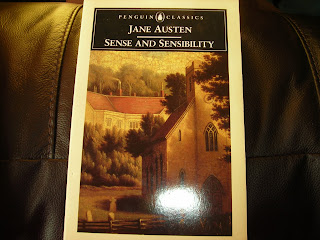 Sense and Sensibility is full of moral tone - the most serious of the Austen books, and sadly lacking in humour, at least to my view. So while I admire Marianne and Elinor, I don't like them - Marianne humiliates herself too openly, and Elinor suffers too humbly, though I understand her better! - and I always thought Colonel Brandon deserved to be loved for himself, not settled for which Marianne does (I always doubted if she truly loved him). Elinor's only love interest Edward lies to her by not confessing he was engaged to someone else - even secretly - when they first meet and spend time together. And he wants to be a parson! Even though he confesses to her, and she spends the novel pining for him, it's because her choices are limited. Austen is not kind enough to throw Elinor any other options - but then Sense and Sensibility is the most realistic of all the Austen novels, because it shows the very real plight of most women in the late 18th and early 19th centuries, dependent as they were on the kindness of relatives in the family if the male figure -husband/father - died. Elinor and Edward do truly love each other, and Edward does suffer for his folly of the secret engagement, so he earns the right to be with Elinor, but I always thought that Elinor and Colonel Brandon were the two most eminently suited for each other. So the meeting of minds and characters is not the same in Sense and Sensibility as are in the two other novels Austen wrote, Pride and Prejudice and Persuasion.
Well, you now know how passionate I am about Jane Austen! One of the ironies for me is that I didn't get to do a course on Jane Austen in university. A whole English degree, 4 years of study, and no course on her....but what I do want to learn more about is the society Austen wrote in, the history of that time, and how that influenced her novels. So I want the annotated version of Pride and Prejudice. Yes, another book recommendation! And it would allow me to expand the number of books I have on Jane Austen, which are not very much considering how much I love her writing!
Eva's post has also made me consider the value of owning more than one copy of a book I love. Her post is wonderful for the memories that each copy that she owns of Pride and Prejudice evokes in her. Eva has shown the covers of the four versions of Pride and Prejudice that she owns. I have to confess that I only own one version of Sense and Sensibility, Northanger Abbey and Emma. It's the Penguin Classics editions. I love Penguin. They are well-bound, the glue hardly ever gives on the paperbacks unless you force the spine back - and even then sometimes the spine doesn't crack! not that I've done this very often, precious books! and they just feel so good in my hand. The smoothness of the cover, the classic portraits or pictures often chosen to grace the cover. Unfortunately for Persuasion I have the Bantam Classic edition, which although it too shows a painted portrait, doesn't feel the same, the printing and page colour are different, and it just feels different in the hand. I will say that their bindings are good also. It's just that I grew up, here in Canada, with the Penguin Classics as the paperbacks that were the best quality and had the best introductions on the books (if we wanted to read it, which I being obsessive-compulsive and wanting to learn, and also read everything from cover to cover, I naturally did!). The Bantam edition has no introduction.
Kailana at The Written World yesterday had a very thoughtful post on book covers and series, here. This is what got me thinking about collections of books, and she raises a very good question: when you are collecting an author, or a series, do you want the editions/covers to all match? Does it bother you if the covers change halfway through the series? For me, when I consider my Penguin editions of Jane Austen's novel all lovingly lined up on the shelf, and then the one sad stand-alone Bantam edition, I confess that it bothers me. It shouldn't, and I decide again to start looking for a Penguin edition of Persuasion.

Very smart readers will notice there is no copy of Mansfield Park. I don't own one yet. I am looking for, of course, the Penguin Classic edition. I will read it one day!
Here is today's Bluenose Ghosts excerpt:
However, all stories of the Teaser are not dismissed that easily. We must go back now to the twenty-sixth of June, 1813, when a privateer, the Young Teazer, was trapped by British warships in Mahone Bay on our southwestern shore. She would have been captured if a young officer had not set her afire rather than swing at the yardarm. I have talked to people whose parents witnessed the event when they saw a huge explosion as she went up in a blaze of fire. Windows were broken at Blandford, so strong was the blast. From that time, and never before, her apparition has been reported. The old people would tell about having her sail to within a couple of yards of their boat and filling them with fear because they were sure they would be run down. In one case a fisherman told how she stood directly in his way and he could hear the ropes creak in the blocks. From Boutilier's Point it was reported that the ropes were all on fire. It was seen then coming to East Chester from Quaker Island at two o'clock in the morning. Again some St. Margaret's Bay men were in a boat near Clam Island when they to get out of the Teazer's way, and they said they could see the crew in the rigging. I have never heard of any calamity following the appearance of this burning ship, but it often seems to have had a frightening effect.
and another, because I have not been able to post this week as much as I'd planned to.
Similarly a Seabright man was on a vessel off the Gaspe coast when another vessel showed up ahead. Telling of it later the captain said, "I was going to speak it because it was so close and I could see the lights and the sails. Something told me to wait till morning and I did. It stayed in sight of us all night and, just before daybreak, one of the crew said, 'Where's the vessel?' It wasn't there. We learned later that we weren't the only ones who had seen it, for it had often been reported there. It was a good thing we didn't speak of it, for that would have been the end of us. You see, if we had spoken it, not realizing she was a ghost ship, that would have been our doom." That, as a Lunenburg fisherman once expressed it, was a fairy of the time - the belief.
Jane Austen Challenge updateI am going to consider this my first review for the Jane Austen Challenge, for
Persuasion. I have read two other books for the challenge, which now that I have done this post, will be coming shortly!


