Showing posts with label Jane Austen. Show all posts

Tuesday, 25 February 2014

"My Dear Cassandra" Jane Austen, Letters to her sister


 My Dear Cassandra by Jane Austen , Letters to her sister, edited by Penelope Hughes-Hallett.  This book came to my attention because of Geranium Cat's post back in December, here. As soon as I read up on the book and saw that it included illustrations, paintings, little facts about the time in which Austen lived, I was hooked.  I had to have this book.  And I am happy to report that it doesn't disappoint.

On the contrary, the letters that Penelope Hughes-Hallett selected show off Jane's wit,  her kindness, her love for her family, her joy in simple things.  The book starts slowly as Jane only started writing letters when her sister Cassandra left the family home when Jane was 20.  Cassandra was the elder, and went to live with various people over the course of her life, seldom returning home except for visits.  In 1796, then, is Jane's first letter to her sister.  She was 20 years old.  The letters then follow Jane from Steventon Rectory, to Bath, to Portsmouth, to the final years back near Chawton where her elder brother had his family home.  We see Jane mature through her own eyes, in the lightness of the first letters, then the seriousness as her father's ill health and death changes her family circumstances, to the eventual home they find in Chawton, back in the countryside she loved.  The novels she was writing make little appearances, in comments she makes, or dialogues between letters about the progress of such.  Her family were very involved in her writing, supporting her, and participating when she read them allowed to her family as they progressed.

Interspersed are paintings from artists and sketches of the day, that show the areas in which Jane lived, clothing, transportation, social expectations, food.  It is a delightful way of recreating the world in which Jane lived, and a glimpse of how she as a writer took what was around her and created her books from.

I came to feel as if I had a glimpse of Jane herself - just a tiny glimpse, a trace of her, in her letters.  When  I would take a break from reading it, so I could savour what I was learning in the periods of letters about her relationships with the people around her, I felt - civilized.  There is so much gentleness in these letters. She could be very cutting, and if she had been a different kind of person, very cruel, but she wasn't.  Jane Austen was - or chose to be - overall, kind.  There is a gentleness to this book that made me realize that it is a tone that is lost for the most part in our world today.  Jane doesn't gloss over death, or sadness, nor does she dwell on it.  Most of her letters were like conversations she was continuing with people she had just spent time with, or that were from letters she had just received.  It would seem all one-sided if not for the fact that Jane doesn't dwell on herself,either.  She is interested in the world around her, in the life and running of her home, in how her relatives are doing, and in her writing, her novels. We get to see how she made fun of many things, turning what could be serious or pedantic thoughts, to wit and humour, to make her point.  She enjoyed outings, but began to find social gatherings tiring as she got older.  She offers advise to her nieces on marriage, and likes to go shopping for cloth for dresses.  She takes lots of walks when she can, which in those days was the main form of exercise for women. 

There are a few letters from other people at the end, when Jane dies.  I didn't think I was so deeply involved in the letters and following them, and seeing the glimpse of Jane in them, until I read Cassandra's letter to her niece Fanny Knight, telling her of the day Jane died.  I ended up crying at my kitchen table, in the middle of the afternoon, feeling the loss of Jane Austen from 200 years ago. 

These letters give a poignant glimpse of her and her family. This book is like a window opening into Jane and the world in which she lived, and it is a treasure.  I loved this book and I highly recommend it.  A must read for Jane fans, definitely.  

Tuesday, 19 February 2013

The Pleasures of Persuasion - Jane Austen

                     I had watched Persuasion on Sunday afternoon, the Ciaran Hinds/Anne Root version.

It doesn't matter which of the many versions there are out there, though; every time I finish the screen version,  I immediately reach for the novel.  There is something about how Anne responds to the world around her that just can't be captured on the screen.  It is an interior novel, through Anne's eyes for the most part, and a movie can't capture those interior thoughts and impressions deeply enough.  It can only show the surface.  So I find the movies always lack a depth that I know Persuasion the novel has.  This time though, I thought I would try one of my annotated versions, Persuasion by Jane Austen - An Annotated Edition edited by Robert Morrison.
                                                                  
 I have not read an annotated version of one of my favourite novels before, so I wasn't sure what to expect.  Too much information?  Would it be difficult to read the story and read all the extra information without losing my place, or the pace and flow of the story?  Well, it helped that Persuasion isn't a fast novel.  It's slow and thoughtful.  This means that taking the time to read the annotated notes on each page was easy to do.  Each annotation had something to do with what was on the page, as well, so it was in keeping with that point in the chapter.

Illustrations grace this edition, so many wonderful images and paintings from the time Jane Austen lived, and of the places mentioned in the novel.  Places that could be like Uppercross or Kellynch, and actual paintings, drawings, and reproductions of maps of  Bath and surroundings, Lyme and surroundings, are all shown in detail. The political changes, and the historical especially: the War with Napoleon is the backdrop to Persuasion, with the war just ending as the novel opens.  Admiral Croft who rents Kellynch, when the Elliotts have to decamp to Bath, has just been released on half-pay as the war is over and he needs a place to live with his wife. And of course, Captain Frederick Wentworth, who has made his fortune in the war, and now seeks a wife to settle down with.

I won't go through the details of the plot, since I will assume that most of you gentle readers have read Persuasion already.  I have as it is one of my very favourite novels.  So I was anxious and curious to see if the annotated version would add anything to what I had already gleaned from my readings, and from reading about Jane Austen herself in her biography by Claire Tomalin.

 Well, I learned a lot.  There is much more to this annotated version than I expected.  It brings in texts and books and ideas and criticisms about Persuasion, that have occurred ever since it was published in 1817.  What the annotated version gave me especially, was an understanding of how Persuasion fits into the world Jane Austen was writing in.  Especially, the literature world then.  I did not understand how much she liked the Romantic poets - even though they are brought up by Anne Eliot in the novel, to Captain Benwick - and that Persuasion is the first novel where she tried to use the setting to show her heroine's mind.  The walk from Uppercross to Winthrop, and the scenery around Lyme are the two big examples of nature being used to show Anne's pain.   In the Uppercross scene, one annotated note says:

"Anne's walk to Winthrop is often cite as an example of Austen's new commitment to a darker and more passionate world in which she values feeling over prudence, and in which she explores her own deep sense of personal sorrow through techniques and natural settings that are more commonly associated with her major poetic contemporaries Byron, Wordsworth, Coleridge, Keats and Shelley......In their quiet and restrained fashion......Austen's last works are part of the new movement in English literature.  She has learned that the natural setting can convey, more surely than any abstract vocabulary, the movements of an individual imagination." p 127

At Lyme, the annotated notes suggest: " In her description of the 'immediate environs of Lyme," Austen comes "nearer to the Romantic poets than in anything else that she wrote," declares Althea Hayter.......Hayter proposes that Austen's own memories of Lyme, coupled with her reading of Coleridge's hypnotic poem [Kubla Khan], might have cast a 'strange glow' over the landscape, and now it would be the dark cliffs, the rocky fragments, the green chasms, the forest trees, that she felt moved to describe in Persuasion, as the setting for Anne Elliott's 'sorrowing heart', secretly yearning for the the love that she believed she had lost forever." pg 141

Now read the actual text of Persuasion for the first glimpse of Lyme and environs:
    " The scenes in its neighborhood, Charmouth, with its high grounds and extensive sweeps of country, and still more its sweet retired bay, backed by dark cliffs, where fragments of low rock among the sands make it the happiest spot for watching the flow of the tide, for sitting in unwearied contemplation; - the woody varieties of the cheerful village of Up Lyme, and above all, Pinny, with its green chasms between romantic rocks, where the scattered forest trees and orchards of luxuriant growth declare that many a generation must have passed away since the first partial falling of the cliff prepared the ground for such a state........."p 140

I stress that neither the annotated notes/author nor myself are suggesting that Jane Austen was becoming a Romantic writer; what jolted me was the understanding that the Romantic poets had moved her , so that she as a writer was trying to use what their poetry was showing her about landscape, and the heart, in her work.

In  Lyme, we the reader are aware that Jane is resigned to having lost Wentworth forever.  She is grieving, she is sorrowful, her heart is broken, yet still she can see the world around her, still respond to nature, and indeed to the grief of Benwick, whom  she is just about to meet. And in that discussion with Benwick, who reads only the Romantics, she suggests that he adds essays and other books to his readings, to give him a sense of morality and resolve to overcome his grief.   It also reveals the true character of Anne Elliott, that in the midst of her own private grief and loss of hope, she can rally - and this is how, by using the guidance of books to show her the way.  I just love how Austen uses books in her novels!

It really bothers me now that in the screen version I have, Anne smiles when she is at Lyme at the beach for the first time. I understand why the actress would show this - the change of scenery, being at the ocean - is renewing, revitalizing - but Anne would be contemplative.  The chasms and luxuriant forest life and rolling ocean would be her outlet to  express the powerful emotions that she is not free to reveal.  She should be shown alone, along the seashore, or gazing out at sea, sadly.  Or smiling ironically, in awareness that the world goes on even when her hopes have ended.  Anne is never bitter, and at the end of her evening with Benwick, she is self-reflective enough to say,
      "When the evening was over, Anne could not but be amused at the idea of her coming to Lyme, to preach patience and resignation to a young man whom she had never seen before; nor could she help fearing, on more serious reflection, that, like many other great moralists and preachers, she had been eloquent on a point in which  her own conduct would ill bear examination."
                                                                                               p 149

I think it's at this point that I know I would love Anne Elliott dearly as a friend.  So while Jane Austen uses nature in a different, modern way, her main character is not Romantic, or tragic.  She is self-aware, reflective, and humourous, and a marvelous creation.  The irony, gentle wit, poking fun - and indeed she might have been poking fun at the tragic Byronic character by making him be Benwick in the novel, who despite his great despair at the loss of his true love, very quickly - too quickly, all agree in the book - falls in love again.  I really enjoyed the Annotated version for giving me a glimpse of Jane Austen the writer at work. 

I love seeing how the books being published in her time affected her writing, and her growth as an author.  I enjoyed reading the bits of criticisms and essays used, although I did not always agree with the ideas, they still gave a deeper meaning to what was happening in the story.

Things I did not know:
- I did not know that Jane loved Scott's poetry, or was a huge fan of Fanny Burney and Maria Edgeworth.  I will have to look for the novels now!
-I did not know that Austen changed the final chapters of Persuasion: she didn't like the original ending, so she cancelled the final two chapters and replaced them with three final ones of the published novel.
-The two cancelled chapters are the only section of any of her published novels to survive in manuscript.

I really enjoyed reading this annotated version.  I loved the notes about other authors and who she admired as a writer, and who admired her.  I enjoyed reading about all the little ideas, character references, other books, that Jane uses in Persuasion, or refers to, or links with. It makes for rich reading, and plunged me into the world of 1812 to 1816.  I think I was even dreaming of Regency England last night.......I loved reading about the differences in carriages, and why Wentworth's removing little Charles from Anne's back is so significant, and the reason why Elizabeth won't invite anyone to dinner, when the Harvilles invite every body. Regency England comes to life in reading this annotated version.

I think I love Persuasion even more, now.

Monday, 6 August 2012

Olympics, new Rebus, and In the Garden with Jane Austen - book review


The Olympics are taking up much of my attention this past week.  I'm getting a little reading done, though only because we had a long weekend so I was able to read in the evening the past few days and finish a book. Darkfire by CJ Sansom, to be reviewed shortly..  I love the Olympics, I enjoy how the athletes try their best.  It's exciting and thrilling and sometimes heartbreaking to watch. 

At the same time, I had to share with you my excitement when I found on Amazon today that a NEW REBUS mystery is coming out!    
 

Yes indeed, John Rebus is back!  He is teaming up with Malcolm Fox, or rather, he and Malcolm cross paths.....all the old favourites are there, Siobhan Clarke, Big Ger Rafferty, and most of all, Rebus.  Still retired, and still pushing buttons and going where no one else wants to go.  Standing In Another Man's Grave isn't released here yet, there is no date out, and I'm still ecstatic.  NEW REBUS MYSTERY!!!! 

I thought for a change of pace that I would actually review a book today.   Some of the high heat and humidity  we have been suffering under have died away today, so that I feel energized and can think straight.  I'm posting while I can.....

In the Garden With Jane Austen by Kim Wilson

This was such a beautiful book.  Gardening and Jane Austen, what could be better? Well, this book takes bits and pieces of letters Jane, her mother, and her sister Casexened to the gardens in her various homes after her death.  It even shows some of the stunning gardens and settings she would have seen in her travels around south England, and wrote about, either to her family, or used as a basis in her books.        
                                           
I learned two big things reading this book:
1) Jane loved to garden and discussed flowers, fruits and vegetables and took an interest in raising the animals that were being raised for food by her family  She learned to raise animals and grow vegetables and fruit while growing up at the parsonage in Steventon, where her father was the rector. She and Cassandra looked after the animals, the chickens and the bees, and they often had what the house gardens and land offered as their main source of food.

2) that walking paths, garden paths, were used extensively in 18th century England.  Ladies didn't run, they didn't work out!  So to keep healthy, walking paths were built into gardens - thus, the ladies could go for several miles of walking if they walked around the gardens several times, depending on where they were living and the kinds of gardens around.  It makes me feel much better about my walking and less guilty that I hate working out (so I don't). Walking is good exercise,! 

I did not know that her brother Francis was wealthy enough to manage a country estate, which they did at Goodnestone Park.  This was the same brother who she visited for a short time in London, and who supported her and her mother after their father died. Goodnestone Park has several gardens,  and Jane visited her brother and sister-in-law frequently there.

There is alist at the back of the book, of the flowers grown in Jane's time. Unfortunately the original gardens at many of the places she lived are long gone now, however the head gardener at Chawton Cottage now (which is a trust historical estate) provided a list of the flowers grown now at the Cottage, with almost all the varieties used being available during the years Jane was alive.
-Hollyhock
-lady's mantle
star of Persia (allium)
basket of gold/gold alyssum
masterwort
sweet William
 dianthus superbe
bleeding heart
geranium Buxton Blue
dogtooth daisy
Little Maid daylily
Madonna lily
winter honeysuckle, Hall's Honeysuckle
moonwort/money plant
maltese cross
yellow daylily
evening primrose
Jacob's ladder
garden phlox
Rosa Alba Belle Amour
Rosa centifolia Shailerss White Moss
black-eyed Susan
satin flower
columbine

I was delighted to see that I have some already in my garden, sweet william, daylilies, phlox, of course roses, money plant, maltese cross (though I can't grow these, they keep dying), Jacob's ladder, black-eyed Susan, alysum, and I dearly want to try growing some Hollyhock next year.

There are many pictures in this book, of the gardens and great houses that Jane would have visited, and pictures of the gardens at Chawton Cottage, old sketches if the gardens or houses don't exist any more, and delightful descriptions from Jane's letters, as well as excerpts from her novels. There are excerpts from gardeners of the time, thoughts on gardens, how to design them, what a successful 19th century garden should contain, the various uses of the garden. 

I found this book to be a delight for the soul.  It is a wonderful way to spend an afternoon, with a cup of tea,  reading about gardens and life in Jane Austen's time.  It gives a rare glimpse of how Jane used the landscape around her in her novels, and when I reread them, I know I will have a better understanding of how she used the garden settings in her books. I love that she loved her gardens and was happiest when she could have one to tend, a cottage with a garden.  She was a woman after my own heart, and since I already love her novels, this is such a deep pleasure to discover about her.


Thursday, 26 July 2012

non-fiction buying frenzy

Ana made my day today.  I have been catching up with all of you lovely bloggers, and I found her post here on upcoming non-fiction books she is excited about.  She asked us if there were any upcoming releases we were excited about.  I decided that I would change the question to, "what books have you been buying that are unusual for you? " Because, dear Readers, tumbling into this house faster than I can read them, are an enormous amount of biographies and histories.  Ok, it won't be an enormous amount for many of you! but for me, it's not usual for me to read or even look at biographies more than once a year.  Here is what has come in over the past few months:


All Roads lead to Austen - Amy Elizabeth Smith.  She goes to Latin America for a year, taking her Jane Austen novels, and leading book clubs in different countries, to see if Jane Austen transfers into other cultures, and what their versions of Jane Austen (or recommended books) are.  It looks very interesting and very fun.  I love the idea of talking about and reading Jane Austen in different countries, and to see how she does cross cultures.  Plus it's about books and reading books, specifically Jane Austen, and a chance to learn about some of the best writers in Latin America from people who read.  It's like being part of book club on the road with her!


The Civil War of 1812 - Alan Taylor.  It is the 200th anniversary of the War of 1812, the war that defined Canada as a land that was not going to be part of the US. This book looks at the war from both sides of the border, and what it meant really - because even back then, families and towns straddled the border, and brothers and cousins fought for one side or the other, depending who they wanted to belong to.  This history looks at the war from the lives of the people who fought it, the soldiers, immigrants, settlers and Indians on both sides of the border.  It looks fascinating.


God's Mercies - Douglas Hunter.   The story of the rivalry between Samuel de Champlain and Henry Hudson (for whom Hudson's Bay is named, as well as the Bay, one of  Canada's largest and oldest household good and fashion store).  They both raced to explore and map the northern half of North America, and find the route to the Far East, in the 17th century, and were to two principal explorers from the St Lawrence River up to Hudson's Bay.  Samuel Champlain came by the Ottawa River, and his sextant was found in a field further up the Ottawa Valley. A statue to him is on a cliff beside the National Gallery of Art here in Ottawa, across the Rideau Canal from Parliament Hill. Here is a link to a little historical view of these two.  One was French (Samuel de Champlain), one was English (Henry Hudson).  The Hudson River in New York is named for him.  Hudson died ingloriously after his crew mutinied while he tried to find the Northwest Passage, while Champlain had success after success in mapping the land through to Georgian Bay.  This  book won one of Canada's Non-fiction prizes in 2007, the Nereus Writer's Trust. As a companion to this I still need to pick up Champlain's Dream by David Hackett Fischer.


A Train in Winter - Caroline Moorhead.  About the friendship between a group of  230 French women resistance fighters who were rounded up from Gestapo detention camps and sent to Auschwitz.  The only train to take women of the resistance to a death camp.  This book explores who they were, why they joined the Resistance, how they were captured and their life in the death camps.  49 women came back. Six of them were still alive in 2010, and were able to share their stories for this book.

                                                  
The Occupied Garden - Kristen den Hartog and Tracy Kasaboski.  A couple live in Holland when the Nazis march in.  Years later they move to Canada, and after their deaths, their granddaughters begin to piece together what happened during the war to their grandparents. They had never spoken of what happened to them in Holland, while alive.  A family memoir that is about life in wartime Holland, something that surprisingly there isn't alot of, in English.  My stepfather grew up in Holland during the war, so I've heard a few stories from him also, but it's not something people talk about often.


The Years of the Sword: Wellington - Elizabeth Longford.  I blame the .99 price tag, and that it has illustrations.  Some day I will read this biography of Wellington and the battle of Waterloo.
                      
                                                        
The Hare with the Amber Eyes - Edmund de Waal.  A family memoir of  a man who explores his family history while uncovering the history of 264 netsukes, Japanese wood carvings that he inherits.  Who handled them?  Where did they come from, what was their history? Along the way he discovers that his family were once a banking dynasty in Paris and Vienna in the 19th century, yet by the end of WW 2, all that remained of this dynasty were these netsukes. This was an award winner when it came out, winning the Costa Book Award for Biography, among others.


The Pre-Raphaelite Tragedy - William Gaunt. 1.99 price, long out of print, about the Pre-Raphaelites' lives - especially their daily lives, with anecdotes more than any long narrative -  biographical studies this kind of  biography is called.  It looks interesting and a good find for my growing Pre-Raphaelite library.  They are among my favourite artists.


Graven with Diamonds - Nicola Shulman.  The Many Lives of Thomas Wyatt, Courtier, Poet, Assassin, Spy.  He is the author of one of my favourite poems, "Whoso List to Hunt, I know Where There is a Hind'.  There are not many biographies out on him.  This is was just published recently, and won the 2011 Best Non-Fiction of 2011 Writer's Guild Award.  I'm fascinated with the Tudor times, and the enormous changes that occurred then, and what life was like at the courts for Wyatt, who was both a courtier and a poet.  Poetry was held in much higher esteem than it currently is, and the best poets could be ironic, witty, and sarcastic, under the guise of poetry.  He avoided being beheaded even though he was thought to have had an affair with Anne Boleyn.  Here is a link to some of his poems online.


John Donne: The Reformed Soul - John Stubbs. Published in 2006, now considered one of the best biographies on Donne.  I am fascinated with his life and how it informed his poetry.  No one could use words and twist them like he could, making one meaning from just the way the words are placed, from what you think they will be.  He struggled with his faith at a time when it was dangerous to have faith, in the Reformation.


Mistress of  the Monarchy- Alison Weir - about Katherine Swynford,  the mistress of John of Gaunt, later to become his wife.  He was the Duke of Lancaster.  This was in medieval England, in the 14th century.  I want to read about how a woman went from being a mistress to the wife of a Duke, and how she survived court in a time when women were mostly used as property.  It looks very interesting.  She wss intelligent and considered one of the beauties of medieval England. 

                                                                        
Shakespeare's Wife - Germaine Greer.   Other than her name, not much is known about Ann Hathaway, the wife of William Shakespeare.  This is the first  major biography of Shakespeare's wife, the woman who bore his children and lived far from the London scene.  Who was she? How did she feel as Shakespeare gained so much acclaim, and she was never by his side?
                      
                                                  
Elizabeth's London - Everyday Life in Elizabethan England - Liza Picard.  This is part of a series of books Liza Picard has written, about daily life in London through the centuries.  This was published in 2003, so fairly new, and covers all the things you wanted to know about Elizabethan England: from House Moving, to Garden Design, to The Bills of Mortality, to The Markets, Cooking and Recipes, Sex Outside Marriage, The lottery, Education, Interiors and Furniture, Clothes and Beauty, Law.  These are chapter headings, and there are many more fun ones!  Just everything you would want to know about life in Elizabeth England.  I have Restoration London and Dr Johnson's London in this series.  Victorian London rounds out the titles.  So if you are looking for a good history of daily life in London in different centuries, this is an excellent series to start with. 

and lastly, bought today, just out in sofcover: 
                                                 

Effie - Suzanne Fagence Cooper.  About the live of Effie Gray, John Ruskin and John Everett Millais, the Pre-Raphaelite painter.  She married John Ruskin first, who on their wedding night turned away from her saying she didn't inspire desire in him.  When Millais was hired  to paint Ruskin's portrait several years later, Millais and Effie fell in love.  She dared to leave Ruskin, and go to live with Millais. This makes it sound boring when it really looks very interesting and intriguing, a love triangle that involves one of England's greatest art critics and one of the Pre-Raphaelite painters. And the woman who caused Victorian England's most scandalous love triangle.  Passion, art, and real life - this is irresistible.

Now the challenge is to find time to read them all!   13 books, one per month, I could feel a challenge coming on. 

So, how about you?  Have you been buying any unusual for you books lately?  Is any non-fiction suddenly drawing your interest?


Saturday, 21 April 2012

In the Garden with Jane Austen

Yesterday was one of those days when it felt like Friday the 13 energy had carried over.  Did you find that too? 

-  Yesterday I learned I have osteoarthitis in both knees now.  And they have been inflamed for over a month now.  Thankfully I have been told how much Tylenol I can take, and it's working.
-I got a cortisone steroid shot in one knee, to try it. The doctor accidentally hit a bone spur in my knee when giving me the shot. There's nothing quite like crying silently while keeping absolutely still. Thankfully it didn't keep hurting afterward (except for the normal deep ache both knees have right now).
-after moaning to myself that I'm under 50, and much too young to be facing the next 40 years of pain management, I decided to go to the last day Nicholas Hoare bookstore was open.
- yes, the bookstore I just discovered a year ago, was forced to close when the National Capital Commission ,a federal body that overlooks parts of the city because we are the capital of Canada, decided to raise the rent 72% suddenly.  No bookstore in the world - no business in the world - could stay open with that.  In spite of protests, letter writing, and stories in the news, the NCC refused to give an answer about why a fashionable, popular, successful bookstore was being forced to close down.  And get this:  there is no tenant waiting to come in.  So instead of regular income, the NCC is wasting our tax dollars because there will be no tenant. 
- I went in to buy some last books and commiserate and say thank you and goodbye.  I bought two birthday presents for my ex, a Mother's Day present for my mother (and just in case they read this, I can't say what they are yet!), and three books for myself:
-Woman with a Birthmark - Hakan Nesser (Chief Inspector Van Veeteren series)
- The Terrorists - Maj Sjowall and Per Wahloo (final book in the Martin Beck series)
and then, a final treat for me:
- In the Garden with Jane Austen by Kim Wilson

I started reading it right away on the bus on the way to work.  It took all the stress and worry from me, and I lost myself in reading about Jane Austen and the gardens she grew in her lifetime.  Did you know that Jane and her family were avid gardeners?  That as daughters of a rector, they grew their own vegetables and fruit as children, and when they finally landed at Chawton Cottage, they had an orchard, and several kinds of gardens - herb, vegetable, flower. Chawton Cottage was one of two that James,  her well-to-do brother offered them.  It was here that Jane lived out the final 8 years of her life, and here where she wrote her final three novels.  He took excellent care of them, redesigning part of the cottage for their comfort, and adding gardens and walkways so that they could take their daily walks. They had chickens, their own fruit and vegetables, flower gardens, herbs, everything a gentlewoman could need to be self-sufficient and in charge of her own home.  Jane delighted in this.

In the Garden with Jane Austen is filled with bits from her letters to Cassandra, descriptions of gardens or walks from her novels, and most wonderfully, pictures of where Jane lived, and descriptions from her letters of the  gardens had.   The ones  at Chawton Cottage have been recreated, and there is an introduction to this book written by Celia Simpson, Head Gardener at Jane Austen's house. I find I didn't know this could be a career choice, but how fabulous and wonderful, to be head gardener now at Jane Austen's house!!  I am discovering, partly because of The Morville Hours, but mostly I have always been interested in the history of plants and gardens, what 16th and 17th century gardens looked like, how they were arranged and used.  So I love seeing the layout of Jane's gardens, and the flowers she grew, and that she had her own orchard. 

There are also photos of the great houses she visited, and around her areas she lived, that would have influenced her writing as well as where she would have walked for exercise. Some photos are  also of  the settings for some of the movies made from her novels.  There are recipes from her time, and drawings and sketches by family members.  Did you know she kept bees, and made mead from the honey?  

This is a lovely book.  It is just the thing to ease care and worry and remind myself of the beauty all around, and that with luck, I will be comfortable enough to get into my garden this year.  I'm toying with a plan to see if I can plant a tiny corner of Jane Austen flowers, what do you think?  I think it would be a lot of fun.  I already have some pinks, though I think I need to replenish them.  When I finish In the Garden with Jane Austen, I will do a post on the flowers she had and loved to grow. 

Here is a link to Jane Austen's House Museum, where there is a virtual tour, and a list of what's on this year.
and with pictures of Jane's Gardens just starting to bloom, here is a link to Jane Austen's House Museum blog.  I'll be coming here regularly now!  I didn't know this existed. 

Once again, a book provides solace and comfort, and while I am very sad to see the end of Nicholas Hoare bookstore here, I have some wonderful books from England (which they specialized in) to remember them by - The Morville Hours, and now In the Garden with Jane Austen.

Has a book brought you comfort lately, or restored your spirits?  Do you walk  in gardens or in nature like Jane Austen did, or Mary Oliver does (my favourite poet), as a way to find beauty and joy in life?  Do you garden?

Thursday, 15 December 2011

Mortal Love, Peter Lovesey, and The World's Wife - reviews!

I have been remiss at writing on here.  I plead shopping for birthdays and Christmas.  And another trip to the emergency room last week.  All that aside,  I have so many books I want to write about that I've read this year!  I've debated on writing about each book separately, or choosing a character series, or grouping them.  I still can't decide, so meanwhile, here are 4 that I have wanted to write about for the past couple of weeks, all of which I highly recommend and really enjoyed.


Mortal Love by Elizabeth Hand.  Remember when I wrote about this book in November, and I was disappointed in it about halfway through?  I am here to say that this is probably the number one reason I don't often blog about a book while reading it - I am often wrong in my assessment, and I am delighted, completely thrilled to say now, I was wrong.  Ok, the beginning of the book is slow, and feels muddled because we are getting viewpoints and stories set in different times.  It all works so very well at the end.  What the book is about, is art, and faerie, and myth, and how when we get a glimpse of the Otherworld, it can shatter us for our daily reality.  It's about how some people spend the rest of their lives trying to capture that moment, that beauty, over and over again.  It's also about how other people find a way to hang on to their sanity, to let the strangeness of the glimpse of the other realm wash over them, and change them so that daily life is enriched, vibrant, and tinged with melancholy because it's not what was glimpsed.  It's about art, and how art changes our perceptions.  And it's brilliant.  I don't want to say who the myth is who is brought to life, because that is part of the mystery and enchantment of this story.  The myth is so well written and brought to life so beautifully that it works.  The reason myths are so powerful is because somewhere deep within us, we know them, we relate to them - this is what gives the myths their power.  It's an archetype we instinctively, deeply in our minds, know without having words to fully explain how and what we know. Mortal Love is about this deeply held knowledge, and how it inspires longing for whoever glimpses the myth.  I highly recommend this book, especially for anyone who enjoys art and wants a glimpse of what it is like to have to write, to paint, to sing, to create.  Once again, here is Nymeth's excellent review which convinced me to try the book.  Thank you, Nymeth!

This leads me to The World's Wife, by Carol Ann Duffy.  This is a collection of poems that take the myths we all know, Greek and Roman and Norse, and give the woman's point of view - the hidden voice, the other, the silent one.  The wife.  The one we never hear about.  What was it like to be married to Aesop?  to Darwin?  to Midas?  to be Penelope, waiting for Odysseus to return - or maybe not. The poems are filled with the voices of real women.  Penelope isn't waiting for Odysseus, pining away - she is enjoying her solitude, and using her cunning in weaving to keep all the suitors away, so she can be alone.  How clever!  and then she hears Odysseus' footsteps and her precious private life is gone.  Mrs Midas is about what it was like after Midas made his wish to turn everything to gold.  Of course he can't touch her, he can't touch anything. She misses the touch of his skin so much.  One of my favourites is Little Red-Cap, which opens this book of poems.  I love how the wolf lures her by holding - what else?  a book of poems.  Poetry.  And how he has a wall of books, and how in the end she becomes free.  It's a true poem, about how knowledge is always the lure, and with enough wits and courage and hunger to know, you can survive the wolf and the woods.  Brilliant.  I thoroughly enjoyed this book of poetry.  It has given me a new way to look at the fairy tales and myths. It  reimagines the world through the eyes of the women who don't explore (or make) the world but who through loving men, and determining if they stay or go in the marriage, find that determination is just as exciting as anything their more famous husbands have done. 

The last book I want to talk about is really an ongoing mystery series by Peter Lovesey,  featuring Peter Diamond.  Last year I reviewed The Last Detective, here.  Now I want to talk about the next two in the series, Diamond Solitaire and The Summons. In Diamond Solitaire, Diamond is on his own.  He quit the force at the end of The Last Detective, and we see him struggle to find his place in the world.  He tries being a Santa Claus, one year!  And it's being a security guard that leads him to find a silent girl asleep in the department store he is guarding.  He is fired as the security guard since he didn't notice her before, and of course it is not as simple as the girl wandering away from her parents.  This little girl is from Japan, and very special. It is delightful to see how protective and caring Diamond is of this abandoned little girl, and when his suspicions are aroused by the people who claim her, he follows them all the way back to Japan.  A very solid second book in the series.  The Summons opens with Diamond depressed because he has not been able to find any permanent work  It's been two years now since he left the force.  Unexpectedly, a summons arrives: a criminal Diamond helped put away, has escaped, and is holding the daughter of the ACC hostage and has asked specifically for Diamond.  The criminal claims he is innocent of the charges.  This is the book about how Diamond discovers he made a mistake, and that he is a policeman through and through.  How he gets his job back, and what he learns while going back over the case and reinvestigating the original crime, makes for a solid mystery with excellent characters and very good dialogue. It's fast-paced and while I spotted who was involved early on,I didn't know for sure, nor why, and I was thrilled when I was right at the end!  which makes for a feeling of being clever (and a really good mystery writer makes the reader feel clever, I find).  I really like this series.  This has to be one of my favourite discoveries in the past year, and I thank Kerrie at Mysteries in Paradise for reviewing the 10th book in the series - Skeleton Hill - last year and pointing me to this character. I also find it hard to resist a series that uses the real life author Jane Austen as a sort of ongoing backdrop to the series.  In The Summons, it is one of Jane's supposed houses that she lived in while in Bath, that plays a part in the book. 

If you have reviewed any of these, let me know and I will link to them.

I hope you are ready for Christmas, and enjoying the season.  We are planning a games party for the children on Saturday, as a way to give them something to do and share in the excitement leading up to the holidays.  As it's my daughter's 9th birthday on Christmas Eve, the tension excitement around here is so high in the final weeks to her birthday that this is when we build our gingerbread houses and try to keep them busy.  We don't have any snow yet, so there is no playing outside and making snowmen. I am enjoying the lack of snow, utterly content to not see any this winter, while my knee continues to heal. No snow means no slippery patches.......no hats, and no boots either!  I could get used to this!

Happy reading moments for you, my Gentle Reader, in the build-up to the big day.

Friday, 25 September 2009

The love of Jane Austen

Eva at A Striped Armchair had a post yesterday about the annotated version of Pride and Prejudice. For just the social commentary, I want this book. In writing my comment to her, I realized that I really want to do a post about Jane Austen.

Jane Austen is the incomparable wonderful exquisite first real female novelist of the English language. I'm not counting gothics here, nor male writers. When I look back in the history of the development of the English novel written by women, she stands foremost, head and shoulders above anyone else. Why does she cast such a beacon? Why are her books still read and loved almost 200 years later?

Eva in her post says that she started reading Jane Austen when she was 11. Eleven! I didn't discover Jane until much later in life. In fact, I can't remember how or when I first read Jane Austen. Just that suddenly, like much that I love, she was there one day, and a permanent fixture in my life. By the time I was 26 she was firmly fixed as one of my favourite writers. The father of my eldest son's best friend (we were all in university at the time, I had gone back to school after having my son, to get my BA in English Literature, and my son's friend's parents were studying at the same university, and our sons were in the same daycare) asked me who my favourite author was. I hate this question. I don't have a favourite author; I have many authors that I really enjoy, and a few that I can't part with, that go with me everywhere. So I said, "Jane Austen." Well, he was stunned, because he and his wife were avant-guarde artists! And here I was saying I liked a stuffy 19th century author most of all! but it's never really changed. And the late 1980's and early 1990's were all about breaking with tradition in the arts and exploring new ways of writing the novel. So I was out of step with the times, but then, I always have been.

My first love with Jane's books has to be with Persuasion. I have no idea when or where I picked it up, just that the first time I read it, was a revelation for me. Not only could I read Jane Austen and understand it without ten million footnotes - anyone who has tried to Clarissa (often thought of as the first epistolary novel in English) or Tristam Shandy will know what I mean - but I laughed. I was delighted, I was moved, I loved Anne and loathed her pretentious family and delighted in Jane's clever put downs of them - which is something you or I might do about pretentious people today. I have always loved Captain Wentworth, who remained faithful in spite of trying to forget her - although my real hero has always been Darcy of Pride and Prejudice. And I've never really forgiven Lady Russell for not seeing through Anne's cousin, even though it was Jane's way of showing that in the end, Anne did learn how not to be persuaded against her better judgement. Persuasion has always been a powerful and gentle novel about the only power a woman had back then, which was who to choose to marry, and how she married - whether for money, or for love.

I might have sought out Pride and Prejudice because of the Colin Firth/Jennifer Ehle tv production from the 1980's; I think I did. I was desperate to know if the book had any more of Darcy and Elizabeth, and to my joy, I discovered that P&P was as full of the witty comments and sparklng wit as Persuasion. It was as even better than the TV show! there was more of Darcy and Elizabeth, and more of Jane's observations of life in early 1800's England. Elizabeth Bennett is my favourite Austen heroine. I would dearly love to meet her and she is someone who I could easily see being my best friend. One of the things I like best about this book is that they reflect and learn on their mistakes.

For me, one of the highlights of Persuasion and P&P are the letters that Wentworth and Darcy send to Anne and Elizabeth. It is the first time that we see the men - these principal male characters - from inside their minds and hearts - and while Wentworth's letter is about a man succumbing to love a second time, Darcy's letter is about a man reaching out to defend himself to a woman he loves. This is the moment when I believe that he does, really love Elizabeth, and the rest of the novel is Elizabeth realizing that she was too proud, too, and didn't realize until too late what a perfect match they were.Darcy's letter shows that he is just, reasonable, kind, loving, honourable, and honest - all the qualities Elizabeth, and we readers, are looking for in the ones we hope to marry. In one masterful swoop, suddenly Elizabeth is no longer the slighted one (he refused to dance with her, sniffing no one in the room could tempt him but her sister Mary, and she was already taken by his friend), but the slightee - she never recognized that he was falling in love with her, although we as readers do, starting with as soon as the first social event is over and Mary and Bingley start spending other dances and social events in eachother's company, Darcy and Elizabeth see eachother, but do not mix yet: "But no sooner had he made it clear to himself and his friends that she had hardly a good feature in her face, than he began to find it was rendered uncommonly intelligent by the beautiful expression of her dark eyes. ......He began to wish to know more of her." And to know Lizzie is enough to love her, as we readers all do. Except that she doesn't realize she is proud, until her treatment of Darcy shows to herself and us that she is, in her way, as proud as he is. And the way that she comes to know him and love him is the same way that he has come to know her and love her - after initial rejection. Oh yes, there is much to love in this novel. Darcy and Elizabeth are to me the perfect couple in English literature - smart, funny, honest, loyal, and they are also flawed - pride being their worst failing, and if I'm honest, it's probably mine as well. P&P is one of the great novels in English literature of all time. Even though it is a novel about love, and manners, the story it tells is timeless. You can change the setting and scenery, but the story is one that everyone tells about how and when they fell in love, too. "Well, first he did this, and I got mad and did this, but then I realized..."No love story ever went smoothly, there are always obstacles to overcome, and P&P is perhaps one of the cleverest love stories ever written. It is also full of social commentary, that explores different views on love that we still try to sort through today. I think this is why it is timeless, and about as perfect a novel on love as can be written.

Wentworth's letter to Anne in Persuasion has the equal effect of revealing his emotions finally to her, and to us the reader. Once again, although we have his exploits as a naval officer and his treatment of his friends - he retains his friends no matter their actual social standing and relative poverty or wealth - it is not until he reaches out to Anne that we see how much he still loves her. Again, we see the themes of love and pride; he doesn't seek her out when he comes to shore, even though he has gained wealth and standing, which were the reasons Lady Russell persuaded Anne to not marry him 8 years ago. His pride was hurt, and he was too angry with her. How human is that? And Anne, who still loves him, is too proud to go to him or let him know that she still loves him. She is too guilty at having rejected him, having understood long ago that she would not have let herself be persuaded against him, if she had known herself and love, when she was young.

So it is not until she opens up to Captain Harville, Wentworth's friend, and they end up discussing who can love best - this such a typical Jane move, to have a woman and a man discuss love in a corner of a crowded room, and only person overhears - Wentworth. And what does he do? Pens her one of the most passionate love letters in English literature, and under the pretense of forgetting his umbrella, comes back into the room and shows her where he has hidden the letter on the writing table for her. *sigh* Now that is romantic! And stylish, and funny, in the setting Jane sets it in!

These are some of the reasons why I love Jane Austen. Pride and Prejudice and Persuasion are two of my favourite novels. Like Eva, I have read them many times now, and seen the tv productions many times. I read them every couple of years. The characters are part of me, Anne and Elizabeth, Darcy and Wentworth, Jane and Bingley.... Whenever we have these questions on our blogs about which literary character would we like to meet/be friends with/have dinner with, Elizabeth Bennett is always at the top of my list.

I could write about Jane's other books, but for me, they show the growth of Jane Austen the writer, and are not as equal in terms of development of character, social commentary, and observations on life, although these qualities are all there to some extent.

Northanger Abbey explores the effect of bad reading on a girl - although Henry Tilney is surely the sweetest male hero ever! and very adorable! ; Mansfield Park has the worst of all the Austen heroines, and I can't read the book - I hate the idea of the story, and the tv version I saw recently was so boring that I read another book and had it on in the background, because I don't like how passive the heroine is.

In Emma, Emma herself annoys me; she is the most cruel of all the Austen heroines, and I have to admit to some satisfaction when she is humiliated by Jane Fairfax and Frank Churchill when their elopement is revealed, although Mr Knightley is another marvellous Jane Austen hero. She too is proud, and yet, when she meddles, it is with the best of intentions (even though it smacks of pretension also), and her humiliation and realization that she isn't a matchmaker at all, makes her finally suitable for Mr Knightley.
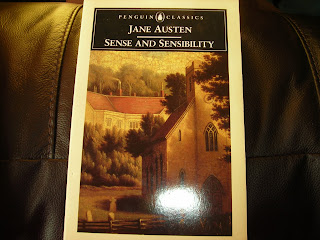
Sense and Sensibility is full of moral tone - the most serious of the Austen books, and sadly lacking in humour, at least to my view. So while I admire Marianne and Elinor, I don't like them - Marianne humiliates herself too openly, and Elinor suffers too humbly, though I understand her better! - and I always thought Colonel Brandon deserved to be loved for himself, not settled for which Marianne does (I always doubted if she truly loved him). Elinor's only love interest Edward lies to her by not confessing he was engaged to someone else - even secretly - when they first meet and spend time together. And he wants to be a parson! Even though he confesses to her, and she spends the novel pining for him, it's because her choices are limited. Austen is not kind enough to throw Elinor any other options - but then Sense and Sensibility is the most realistic of all the Austen novels, because it shows the very real plight of most women in the late 18th and early 19th centuries, dependent as they were on the kindness of relatives in the family if the male figure -husband/father - died. Elinor and Edward do truly love each other, and Edward does suffer for his folly of the secret engagement, so he earns the right to be with Elinor, but I always thought that Elinor and Colonel Brandon were the two most eminently suited for each other. So the meeting of minds and characters is not the same in Sense and Sensibility as are in the two other novels Austen wrote, Pride and Prejudice and Persuasion.

Well, you now know how passionate I am about Jane Austen! One of the ironies for me is that I didn't get to do a course on Jane Austen in university. A whole English degree, 4 years of study, and no course on her....but what I do want to learn more about is the society Austen wrote in, the history of that time, and how that influenced her novels. So I want the annotated version of Pride and Prejudice. Yes, another book recommendation! And it would allow me to expand the number of books I have on Jane Austen, which are not very much considering how much I love her writing!

Eva's post has also made me consider the value of owning more than one copy of a book I love. Her post is wonderful for the memories that each copy that she owns of Pride and Prejudice evokes in her. Eva has shown the covers of the four versions of Pride and Prejudice that she owns. I have to confess that I only own one version of Sense and Sensibility, Northanger Abbey and Emma. It's the Penguin Classics editions. I love Penguin. They are well-bound, the glue hardly ever gives on the paperbacks unless you force the spine back - and even then sometimes the spine doesn't crack! not that I've done this very often, precious books! and they just feel so good in my hand. The smoothness of the cover, the classic portraits or pictures often chosen to grace the cover. Unfortunately for Persuasion I have the Bantam Classic edition, which although it too shows a painted portrait, doesn't feel the same, the printing and page colour are different, and it just feels different in the hand. I will say that their bindings are good also. It's just that I grew up, here in Canada, with the Penguin Classics as the paperbacks that were the best quality and had the best introductions on the books (if we wanted to read it, which I being obsessive-compulsive and wanting to learn, and also read everything from cover to cover, I naturally did!). The Bantam edition has no introduction.

Kailana at The Written World yesterday had a very thoughtful post on book covers and series, here. This is what got me thinking about collections of books, and she raises a very good question: when you are collecting an author, or a series, do you want the editions/covers to all match? Does it bother you if the covers change halfway through the series? For me, when I consider my Penguin editions of Jane Austen's novel all lovingly lined up on the shelf, and then the one sad stand-alone Bantam edition, I confess that it bothers me. It shouldn't, and I decide again to start looking for a Penguin edition of Persuasion.

Very smart readers will notice there is no copy of Mansfield Park. I don't own one yet. I am looking for, of course, the Penguin Classic edition. I will read it one day!
Here is today's Bluenose Ghosts excerpt:

However, all stories of the Teaser are not dismissed that easily. We must go back now to the twenty-sixth of June, 1813, when a privateer, the Young Teazer, was trapped by British warships in Mahone Bay on our southwestern shore. She would have been captured if a young officer had not set her afire rather than swing at the yardarm. I have talked to people whose parents witnessed the event when they saw a huge explosion as she went up in a blaze of fire. Windows were broken at Blandford, so strong was the blast. From that time, and never before, her apparition has been reported. The old people would tell about having her sail to within a couple of yards of their boat and filling them with fear because they were sure they would be run down. In one case a fisherman told how she stood directly in his way and he could hear the ropes creak in the blocks. From Boutilier's Point it was reported that the ropes were all on fire. It was seen then coming to East Chester from Quaker Island at two o'clock in the morning. Again some St. Margaret's Bay men were in a boat near Clam Island when they to get out of the Teazer's way, and they said they could see the crew in the rigging. I have never heard of any calamity following the appearance of this burning ship, but it often seems to have had a frightening effect.

and another, because I have not been able to post this week as much as I'd planned to.

Similarly a Seabright man was on a vessel off the Gaspe coast when another vessel showed up ahead. Telling of it later the captain said, "I was going to speak it because it was so close and I could see the lights and the sails. Something told me to wait till morning and I did. It stayed in sight of us all night and, just before daybreak, one of the crew said, 'Where's the vessel?' It wasn't there. We learned later that we weren't the only ones who had seen it, for it had often been reported there. It was a good thing we didn't speak of it, for that would have been the end of us. You see, if we had spoken it, not realizing she was a ghost ship, that would have been our doom." That, as a Lunenburg fisherman once expressed it, was a fairy of the time - the belief.


Jane Austen Challenge update
I am going to consider this my first review for the Jane Austen Challenge, for Persuasion. I have read two other books for the challenge, which now that I have done this post, will be coming shortly!

Saturday, 4 July 2009

Jane Austen Challenge - I could never resist this!!!

Stephanie at Stephanie's Written Word is hosting her very first challenge, starring one my favourite writers, Jane Austen. The Everything Jane Austen Challenge, lets you choose 6 things, any thing with Jane - about her, by her, featuring her or her characters in some way - from July 1, 2009, to Jan 1, 2010. This means anything - one challenger is making a quilt and making three recipes from the Jane Austen Cookbook. So, if you have a needlepoint cushion featuring Jane in some way, hidden away, or have been waiting for an opportunity to watch the entire 6 hours of the best version of Pride and Prejudice ( the one featuring *Colin Firth* and Jennifer Ehle), or watch the entire oeuvre of Jane Austen movies/tv productions available, now is your chance! Stephanie has a wonderful list of Jane-related books and movies also availabe on her site to choose from.

Well, I had two books to read, and was wondering which of the films I wanted to see or novels to reread when, miracle of miracles, at the old used bookstore I used to work at many eons ago - the Bookmarket - I found an out-of-print book that I had given up on finding a few years ago: Letters to Alice, On First Reading Jane Austen, by Fay Weldon.

I think I might have made an audible sound of joy. There is no other way of describing that 'eep' 'eeek' 'oh' and 'ah' mixture that escapes when I first see a book unexpectedly, and joyfully. That book went into my hand and I clutched it all the way home. I'll talk about the other books another time, but this was such a thrill to find. I don't have the book with this cover - I'd give a lot to find that editon!! - my edition (Coronet) alas does not have the cover available on Amazon.co.uk, as it's an English paperback version. It's nothing like that, but does feature Jane on the cover. And, it's about reading Jane Austen and writing. How to be a reader, and how to be a writer. Perfection.

So, this is my Jane list:

Books:
1. Letters to Alice, on first reading Jane Austen - Fay Weldon
2. Pride and Prejudice and Zombies - Jane Austen and Seth Grahame-Smith
3. Persuasion - Jane Austen
4. What Jane Austen Ate and Charles Dickens Knew - Daniel Pool

movies:
1. Persuasion - version with Ciaran Hinds and Anne Root
2. Lost in Austen

I don't own Lost in Austen yet, but I've found a video store that carries it.

Now, for those of you who think they want to do more than 6 things with Jane this year, there is already a mini-challenge: one of Stephanie's challenge acceptees, Austenprose, has created a mini-challenge to read or do something with 12 things featuring Jane: Everything Austen Challenge xTwo!! I'm a double winner here - I can easily do 12 things featuring Jane in 6 months! And I've found a new blog that is all about Jane Austen's writings! *sigh*

Of course, what I really want to find is the Jane Austen Cookbook. I saw it years ago in a bookstore and didn't buy it, and now I'm regretting it....actually I regretted a few hours after leaving the bookstore not picking it up. And I haven't seen it since!
Oh dear. I went to Amazon.ca, and it was there. Oh dear, I bought a copy. Hmm. I'll figure out some way to explain it to my wonderful husband. So, when it arrives, I will be making two or three recipes from it. There, I'll tell him I needed it.

So, now that I have given in to the dark side (Empire Strikes Back is playing on the tv in the background today, for my daughter. I've given in to the dark side! Or maybe it's the light, nothing about Jane is dark side!!!), I think I will also join the Everything Austen X Two challenge also.

So my 12 things featuring Jane Austen are to be chosen from this list (I am beginning to realize that I need some room to choose what I feel like reading or seeing, or I feel too pinned down and this is supposed to be fun!) now:

Books:

1. Letters to Alice, on first reading Jane Austen - Fay Weldon
2. Pride and Prejudice and Zombies - Jane Austen and Seth Grahame-Smith
3. Persuasion - Jane Austen
4. What Jane Austen Ate and Charles Dickens Knew - Daniel Pool
5. Jane Austen: A Life - Claire Tomalin (a re-read)
and from among:
6. The Private Diary of Mr Darcy - Maya Slater
7. Rude Awakenings of a Jane Austen Addict - Laurie Viera Rigler
8. Confessions of a Jane Austen Addict - Laura Viera Rigler
9. Jane Austen Ruined My Life - Beth Pattillo
10. Pride and Prejudice - Jane Austen

movies
:
1. Persuasion - version with Ciaran Hinds and Anne Root
2. Lost in Austen
3. Pride and Prejudice (Keira Knightley version, I don't have Colin and Jennifer in DVD yet)
possibly
4. Northanger Abbey (latest ITV version which I loved)

Cookbook:
The Jane Austen Cookbook - Maggie Black, Deirdre Le Fayre
- 2 recipes

There. Everything Jane, indeed, for the next 6 months!!!

Thursday, 30 October 2008

Northanger Abbey


I am sitting here listening to Vivaldi, wondering if Jane Austen heard it while she was writing her novels. Did Vivaldi's music come quickly to England, or did it arrive after her death? It's not really important, but there is something in his violin concertos, which I especially like (Konzert 11, d-moll 565 is what is playing) that reminds me of the quickness of repartee, and all the dancing and social events, in Jane's novels. We take music for granted in this century. It's available 24 hours a day, and anything we want can be played. Back in Jane's time, of course, music could only be heard if someone was around to play an instrument. So young ladies who could play were in great demand!
Northanger Abbey is a novel about a young girl coming out in society; it is moreover, a novel about a girl who is not skilled at anything, who comes from the countryside to the town of Bath for a visit. Being from a kindly and dull family, she has no 'wit' or effortless repartee skills that her new friend Isabella has; nor does she have any fortune. What she does have is a kind heart, that allows her to bear all kinds of company with no complaint, and she also has one other quality that all of Jane Austen's heroines bear: honesty. Catherine cannot bear dishonesty, and when she is put in a position by a potential suitor's actions, she is dismayed, and she acts on it: 'If I could not be persuaded into doing what i thought was wrong, I never will be tricked into it.' She is no push-over, and this is very important, because above all, Catherine is silly. She has absolutely no thoughts about anything except Gothic novels and the places such novels are set in. They are all she reads, because history is dull and boring.
In having a dear, sweet, practically brainless heroine, Austen is able to be as ascerbic as she likes in commenting on the society around her. From making fun of Catherine's feelings and torments as she falls in love with Henry Tilney, to the absolute embarrassing idea Catherine develops that Henry's father murdered his mother, to her being sent home in ignomy by carriage alone for a 70 mile trip, and which Catherine is not afraid, not humbled, but rather wonders what she did, what Henry feels when he finds out, and how her family will feel - Catherine and Jane Austen turn the world of the Gothic novel and indeed, most 'female' novels on their head. Catherine faces no danger, does not need to be rescued by Henry at any point. And yet, and yet. She does come to see for herself, by herself, that Isabella is a tease, a flirt, and not a trustworthy friend; she is able to face down her brother, Isabella and Isabella's brother when they are trying to persuade her to break an engagement she has just made with Eleanor and Henry Tilney, and her inability to really hold any kind of deep conversation or learned conversation on anything is more the result of her family (her parents are kindly and dull, dull, dull with nary an opinion really on much and can't get stirred about much either) and her background - from the tiny village of Fullerton, than any lack of intelligence in her. She does talk with Henry and here is a perfect example of Austen's wit and comment on dating:
"She was heartily ashamed of her ignorance. A misplaced shame. Where people wish to attach, they should always be ignorant. to come with a well-informed mind is to come with an inability of administering to the vanity of others, which a sensible person would always wish to avoid. A woman especially, if she have the misfortune of knowing any thing, should conceal it as well as she can."
Oh, I dearly wish I could have met Jane Austen and talked with her! The advice above is still being repeated today to girls!! Yet Jane means it ironically - and probably knew many women who pretended to be dumb to get a man - just as we still do today. This probably began the first time there was two women and a man in cave man times: one women would be herself, and the other would play helpless.....I leave it to you to guess how that one played out! However, enough of the smart women must have won out because the human race has continued, though it is doubtful any lessons have been learned from cave man times on.
I pointed out Catherine's honesty, because I was thinking about Austen's other heroines and began to see that despite their faults and flaws, every one of them - Anne, Emma, and Elizabeth - also share one quality: they are unfailingly honest. Emma doesn't mean to hurt with her matchmaking skills, she thinks she is helping her friend; Anne never says she doesn't love Wentworth when she first breaks the engagement, she just says she doesn't think it wise to marry when he has nothing but his face to recommend him; and Elizabeth is too proud by far, and is not leading Darcy on (as her other suitor claims is the practice of women to do) by refusing the first offer; she genuinely doesn't recognize he is her equal yet, and that she could love him. Catherine may be simple, but she is quick to learn, and she recognizes her own follies as well as everyone else's; all she wants to become a better-read/more knowledgeable person, is better company to keep.
It does still puzzle that Henry could fall in love with her, but Austen says that he fell in love with her this way:
"for, though Henry was now sincerely attached to her, though he felt and delighted in all the excellencies of her character and truly loved her society, I must confess that his affection originated in nothing better than gratitude, or, in other words, that a persuasion of her partiality for him had been the only cause of giving her serious thought. It is a new circumstance in romance, I acknowledge, and dreadfully derogatory of a heroine's dignity; but if it be as new in common life, the credit of a wild imagination will at least be all my own."
And how often in our own lives and families, did romance and true love begin because someone told us someone else liked us, or thought we were cute, etc? In what I think is the crucial scene in the novel, Catherine reveals that she knows nothing of drawing, and Henry begins to instruct her in the beauty of the natural setting around them, and Catherine 'so hopeful a scholar': 'his instructions were so clear that she soon began to see beauty in every thing admired by him, and her attention was so earnest, that he became perfectly satisfied of her having a great deal of natural taste.' It is this that shows them together, naturally, and that they are suited to one another. From the very beginning of their meeting, I wanted them together, and as a romance novel this is as sweet as any of Austen's novels.

I have finished RIP3 Challenge with this book, but since I have to review Tamsin (tomorrow with any luck), I will save my final thoughts until then. However, Northanger Abbey does fit in. If nothing else, Catherine's fanciful imagination has been led astray by reading only Gothic novels. Henry himself has read most of Ann Radcliffe's books, so they can converse on The Mysteries of Udolpho with ease. But when he quizzes her on other books, she confesses she finds them too dry. and herein we find an old debate that rages today, whether one should read only fiction, or try to read non-fiction - and thus better one's knowledge of the world. I'm not debating that here. But it is interesting that Jane Austen takes the side of reading widely - she does not say Gothic novels are bad, just that reading only them reveals a mind that is not curious about the wider world. My guess is that Henry will lead Catherine into reading more. One scene at the end of the book suggests that Catherine reading Gothic novels only is sprung from her parents, her mother especially, who gives her "The Mirror" to instruct her daughter in how to behave!!

If you are in the mood to laugh out loud, to poke fun at society's pretensions, to roll your eyes at the sheer silliness of people (all Mrs Allen talks about is her dresses!!), then Northanger Abbey is a delightful book to choose. If you are in the mood for romance, for true love, Northanger Abbey has that too. If you are in the mood for England, and a bit of English society, pick this book up. And most of all, if you want a delightful companion to lead you through a light-hearted, caustic look at dating in merry old England, this book is for you too.

However, while this was read for RIP3, if you are looking for a creepy setting, horror, scary events, dark scenes, this is not the novel for you. It makes fun of them, without scaring anyone. Not at all like the Scary Movies series! I do love that we do go to an Abbey in the book and get an inside look at a fine English house, but because Catherine has an 'undiscerning' eye, we are not given much period detail at all. The weather (it rains a lot in this book!), and the character of Mr Tilney himself (the father), are far more frightening than anything Catherine can conjure in her mind. He is domineering, and erratic, and that is probably the hardest part of the novel to read. There are no ghostly moments, just Henry making fun of Catherine when he is setting her up for the abbey before seeing it, making fun of what her Gothic-filled mind is conjecturing. Reading Gothics, and horror novels, is silly, and fun. So I guess the question 200 years later, is are there any horror novels or ghost stories that are serious works of literature? Dracula is the only one that comes to mind. Then, we end up in discussing what kind of book is art, or literature, and how we define that.....

I love Jane Austen. After reading this and Tamsin earlier this week (review to follow, also a wonderful, wonderful ghost story), my faith in novels is happily restored.